Lord of Eviellan
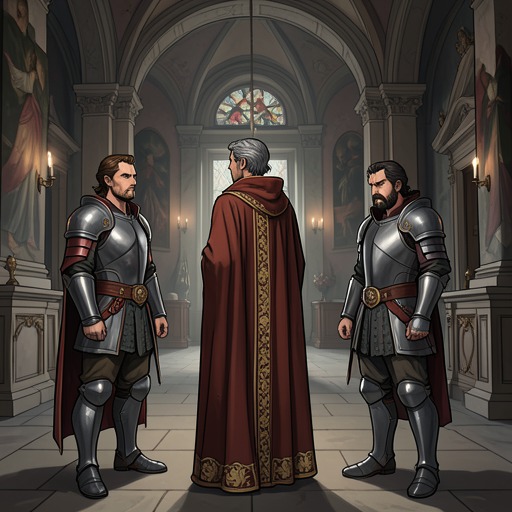
De brief voor de KoningLord of Eviellan is the younger son of King Unauwen and the self-proclaimed ruler of a neighboring land he conquered. His story turns a dispute over succession into a crisis for an entire realm: appointed to govern its south, he pursues independent power, rejects his father’s authority, and makes Eviellan the center of an enduring breach between father and son. His rule brings order within the conquered territory, but not peace between the kingdoms.
Identity and Background
Lord of Eviellan was born on the same day as his elder brother, the Crown Prince of Unauwen, and was younger by only a few minutes. The brothers looked alike and were alike in intelligence, but their temperaments diverged as they grew older. The Crown Prince resembled their father in putting the welfare of the realm and its future subjects first; the younger prince was described as power-hungry. Their closeness in age and appearance did not soften the difference in their positions. Instead, the younger prince regarded the small gap that made his brother heir as unjust, and came to hate him.
King Unauwen repeatedly tried to reconcile his sons and persuade the younger prince to accept his place. On one principle, however, the king would not yield: the realm must remain whole and be governed by the person designated to succeed him. His decision to appoint the younger son governor of the southern Province of the River Streams was an attempt to give him authority without dividing the kingdom. That arrangement became a route to greater independence rather than a settlement of the brothers’ dispute.
Conquest and Break with the Crown
As governor, the younger prince increasingly acted on his own authority, sometimes directly against his father’s wishes. He then marched south into Eviellan, conquered it, and made it a province of Unauwen. King Unauwen revoked that decision and ordered his son to withdraw. The prince answered by declaring himself king of Eviellan and his father’s equal, claiming that he no longer had to obey him.
The declaration transformed a conflict over the limits of delegated rule into open defiance. King Unauwen removed his son from the governorship, but the prince refused to accept the dismissal. Many people in the Province of the River Streams supported him. The Crown Prince came with an army to take over the governorship, and the resulting fighting pitted the brothers’ adherents against each other. The Crown Prince’s side prevailed, yet the victory did not restore the former peace: the account describes friendship and harmony as having disappeared from parts of the realm.
Rule of Eviellan and Continuing Conflict
Eviellan had previously been associated with raids into Dagonaut. Its stone strongholds belonged to lords who had often fought one another or launched cross-border expeditions. Seven years before Ristridin recounted the history, King Unauwen’s younger son went there, conquered it, and proclaimed himself king. He ruled firmly and put an end to the local feuds and raiding. This record complicates any simple equation of his rule with disorder: within Eviellan, his authority brought an end to patterns of fighting that had long troubled the land.
That local consolidation did not settle the larger political conflict. After breaking with King Unauwen, Lord of Eviellan sent bands of fighters into his father’s country to stir unrest. Although there was no formal declaration of war, fighting continued along the border and in the south. The raids also drew in Dagonaut: when forces from Eviellan and Unauwen traveled along Dagonaut’s Third Great Road and clashed there, they damaged estates and set villages alight. Dagonaut’s knights considered these incursions an intrusion into their own territory and pursued the fighters across the border, one such pursuit leading into Vorgóta Forest.
Reputation and Uncertain Peace
Lord of Eviellan had long been an enemy of Edwinem, who had fought many of his knights. Edwinem nevertheless distinguished between their hostility and the conduct of the men he faced: none of those knights, he said, had overcome him or behaved dishonorably toward him. The distinction matters to Edwinem’s judgment of the lord. He does not treat the history of conflict as proof that every encounter will be treacherous; his unease arises from his personal knowledge of the ruler and his suspicion that the promised peace may not be genuine.
Rumors circulated that Lord of Eviellan might reconcile with his father, and Edwinem had welcomed the possibility. But the prospect remained uncertain. Edwinem feared that the ruler did not truly want peace, even while acknowledging that he could be wrong. He described the lord as gracious in manner and strikingly like the Crown Prince, a resemblance that could make his bad character difficult to believe and therefore make him dangerous. The account leaves the reconciliation unresolved: reports of a change exist, but no confirmed change in the lord’s conduct is established.
Political Significance
Lord of Eviellan’s defining conflict is not simply that he takes a neighboring land, but that he turns a grant of authority into a rival claim to kingship. His father’s insistence on an indivisible realm, his own refusal to accept the succession, and the Crown Prince’s intervention make the family dispute a constitutional and military crisis. The consequences extend beyond the royal household: the continuing raids unsettle Unauwen’s south and bring violence onto Dagonaut’s roads and settlements.
The contrast between his firm rule in Eviellan and his continued defiance elsewhere gives his role its particular tension. He ends the old feuds inside the land he conquered while helping perpetuate conflict across its borders. His possible reconciliation with King Unauwen offers hope to those who want peace, but remains a possibility rather than an outcome. In the evidence available here, he is defined by that unresolved divide: a ruler capable of imposing order in Eviellan, yet still at the center of a fractured realm.